Manufacturers, importers and distributors of chemical products often focus on preparing a Safety Data Sheet (SDS) when introducing a substance or mixture to the market. However, ensuring that the document remains accurate and compliant is equally important. An outdated Safety Data Sheet may expose businesses to legal penalties, regulatory enforcement, operational disruptions and potential liability.
Under the EU REACH Regulation, suppliers have specific obligations to update Safety Data Sheets when relevant new information becomes available. This article explains when SDS updates are required, what penalties may apply in Poland and how companies can maintain compliance with European chemical safety legislation.
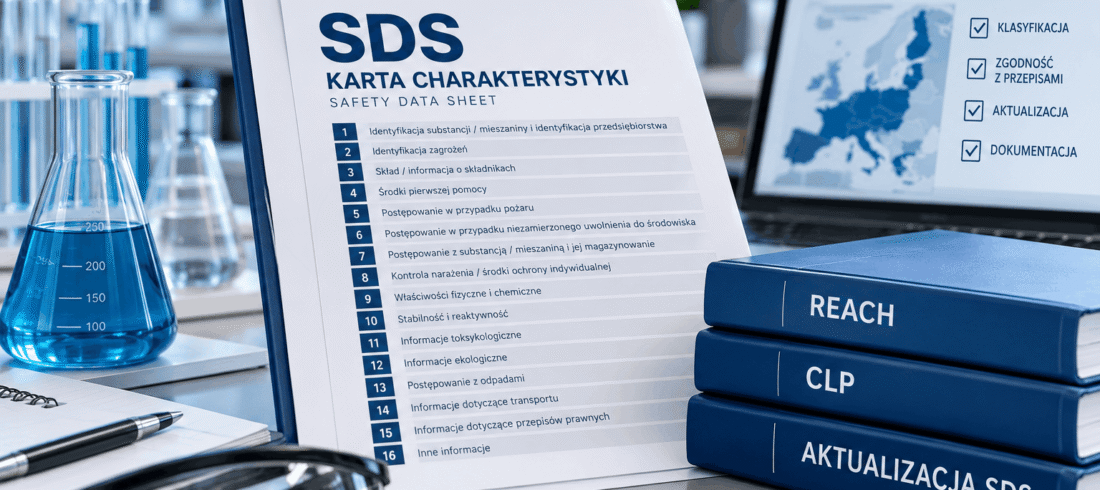
A Safety Data Sheet (SDS) is a technical document providing essential information about the hazards associated with chemical substances and mixtures. It includes guidance on safe handling, storage, exposure controls, emergency procedures, disposal and other important safety considerations.
Safety Data Sheets are governed by Regulation (EC) No 1907/2006 (REACH). Where an SDS is required, suppliers must ensure that it contains accurate, relevant and up-to-date information in accordance with Annex II of REACH, as amended by Commission Regulation (EU) 2020/878.
No.
A common misconception is that a Safety Data Sheet remains compliant indefinitely after its initial preparation. Although EU legislation does not establish a general expiry date for SDS documents, Article 31(9) of REACH requires suppliers to update them without delay when specified circumstances arise, including new information about hazards or risk management measures, the granting or refusal of an authorisation, or the imposition of a restriction.
An SDS review or revision may be necessary in situations involving:
Safety Data Sheets are used by employees, occupational health and safety specialists, laboratories, industrial facilities, emergency responders and regulatory authorities. When these documents contain outdated or incorrect information, businesses and professional users may make decisions based on inaccurate safety data.
This may result in:
Enforcement of REACH and CLP requirements is the responsibility of national authorities in individual EU Member States. In Poland, several institutions may verify chemical documentation, depending on the type of product, business activity and applicable legal requirements.
Relevant Polish authorities may include:
During an inspection, authorities may examine whether the required Safety Data Sheets have been provided, whether they contain the necessary information and whether the documentation reflects the current classification and applicable regulatory requirements.
Where non-compliant chemical documentation is identified, the competent authority may require the responsible business to take appropriate corrective action, depending on its statutory powers and the circumstances of the case.
This may involve revising Safety Data Sheets, correcting inaccurate information and supplying updated documentation to relevant recipients. Under Article 31(9) of REACH, a new dated version must be provided free of charge to former recipients supplied with the substance or mixture during the preceding 12 months when the specified update obligations apply.
Failure to comply with SDS obligations may result in financial penalties under the national legislation of the EU Member State concerned. REACH establishes harmonised chemical safety requirements, while Member States are responsible for implementing and enforcing penalties for infringements.
In Poland, Article 52(2) of the Act of 25 February 2011 on Chemical Substances and Their Mixtures provides for a fine when a supplier provides an outdated Safety Data Sheet in breach of Article 31(9) of REACH. The applicable legal consequences depend on the specific infringement and relevant national provisions. There is no single fixed SDS penalty applicable throughout the European Union.
Depending on the nature and seriousness of a regulatory infringement, competent authorities may take measures affecting the availability of non-compliant chemical products on the market. Such measures are not an automatic consequence of every outdated SDS and must have an appropriate legal basis.
For businesses, regulatory intervention may lead to:
Where inaccurate or outdated safety information contributes to an incident causing injury, property damage or environmental harm, the responsible business may face civil liability under applicable national law. Liability depends on the circumstances, including the relevant legal duties, causation and the damage suffered.
Potential situations may involve:
Regulatory compliance and reliable chemical documentation are important considerations for manufacturers, distributors and industrial customers. Business partners may require current Safety Data Sheets before approving suppliers, accepting deliveries or proceeding with commercial agreements.
Outdated documentation can therefore contribute to:
Regular SDS compliance reviews help businesses identify outdated information and determine whether revisions are necessary. An effective documentation review should consider:
If uncertainties arise, a professional review can help determine whether the existing documentation remains compliant or requires revision. SpecChem supports chemical manufacturers, importers and distributors through Safety Data Sheet preparation, review and updating services.
One of the most effective approaches is to establish an internal procedure for managing and periodically reviewing chemical safety documentation.
Businesses should:
Implementing these measures can help businesses reduce compliance risks, improve chemical safety management and maintain appropriate documentation for products supplied to European markets.
An outdated Safety Data Sheet is more than an administrative concern. Non-compliant documentation can lead to regulatory penalties, difficulties during inspections, disruption of business operations and potential liability where incorrect safety information contributes to damage.
For chemical manufacturers, importers and distributors, maintaining accurate Safety Data Sheets is an essential part of meeting applicable REACH obligations. Rather than treating SDS updates as a routine annual formality, businesses should establish procedures to identify changes that trigger mandatory revisions and keep chemical safety information reliable.
Properly maintained chemical documentation supports workplace safety, regulatory compliance and business credibility. If your company needs assistance reviewing or updating its Safety Data Sheets, explore SpecChem’s professional SDS services or contact SpecChem to discuss your documentation requirements.